

As a Salesforce partner that also implements ERP systems, we are often asked which CRM a company should use. There is no single right answer. These are the factors our certified architects weigh.
When Salesforce is the stronger choice
- Large or growing sales and service teams with complex territories, roles and approvals.
- Customer portals, partner communities or field service at scale.
- Many integrations with marketing, telephony and other systems.
- Advanced automation and AI with Flow, Einstein and Agentforce.
When an ERP-integrated CRM is the better fit
- Small or mid-sized teams where sales, invoicing and stock are handled by the same people.
- A need for one system and one bill, with minimal integration.
- Processes that are simple: leads, deals, quotes, orders and collections.
The integration question
If you choose Salesforce, it usually needs to connect to your ERP for products, prices, orders, invoices and payments. We design these integrations so each record has one owner and data does not drift between systems. With an ERP-integrated CRM, that integration is built in.
Total cost of ownership
Compare licences per user, implementation, integration and admin effort over three to five years. Salesforce often costs more but scales further; an integrated CRM costs less and is simpler to run.
A common hybrid
Some clients use Salesforce for sales and service teams and an ERP such as ERPNext or Reckon ERP for finance and operations, connected through APIs. This gives each team the best tool while keeping one version of the customer.
Frequently asked questions
Can we move from an ERP CRM to Salesforce later?
Yes. Leads, accounts and deals can be migrated when the team outgrows the integrated CRM.
Related reading
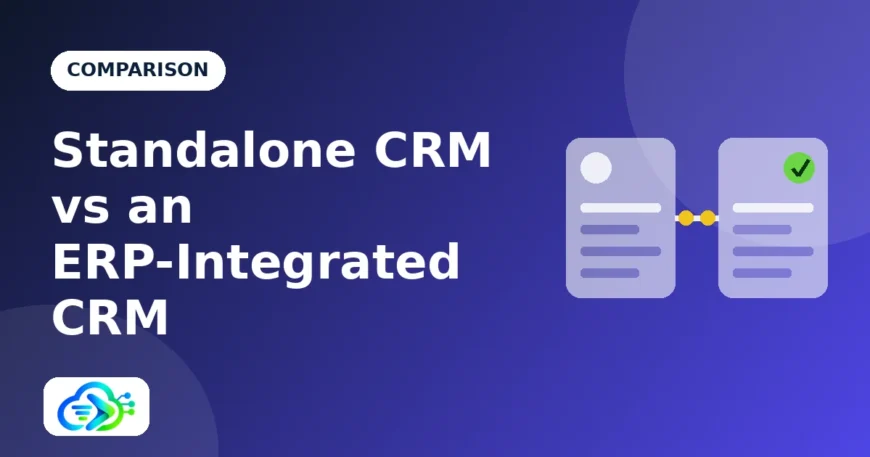
For the product view of this topic, read Standalone CRM vs an ERP-Integrated CRM on the Reckon ERP blog.
Planning a project? Book a free consultation with our team, or see our Salesforce consulting service.

